Not all those who wander are lost.

Not all those who wander are lost.

Saturday, October 5, 2019

Fun food facts

Uganda’s geography is very different from ours, as they are close to the equator.
Day break is at 6am and nightfall is between 6 and 7pm daily, all year round.
They only have two seasons here, rainy and dry. It is currently the rainy season.
It rains every day for a little while. I seriously need to find some rain boots. The
temperature is very pleasant.  In the week I’ve been here it has not been above
78 degrees. I have a hate/ hate relationship with a rooster near my apartment.
He starts crowing at 4 am, two hours before my alarm goes off. There is also a
cow somewhere near here but I am not sure where. I can hear everything very
well because the tops of the windows are actually just wooden slats and not glass
windows. This is to allow a breeze to continually flow, as no one that I have
encountered here has air conditioning. And quite frankly, the temperature is so
pleasant that no A/C is needed.


A little bit about what I am eating here.  My first evening here I met with some staff
from the school and we went to a restaurant next door to my apartment. I had a
vegetable samosa, which is a fried vegetable pie, and a cup of excellent African
spiced tea. I loved it so much that I have found the spice blend at the supermarket
up the block from my apartment. The supermarket has two floors, groceries on the
bottom floor and everything else on the top floor.  It is a super Walmart on steroids.
It is located inside the hugest market I’ve ever seen in my life called Capitol
Shoppers Market. Seriously, if you can’t find it here then it doesn’t exist. Most of
the vegetables in the market are local products and - not kidding- still have some
dirt on them. Capitol Shoppers has several restaurants inside of it, one of which--
Taste Budz -- I visited on Tuesday and purchased Pizza and french fries -- which
they call chips, like the British do. The french fries were yellow but tasty. I did not like
the vegetable pizza. The tomato sauce wasn’t “tomatoey” enough. On a good note,
the cheese didn’t bother my stomach as much.  And, FYI, there is a surcharge on
to go orders at some restaurants here. There is an amazing vegetable
and herb garden maintained by the agriculture classes at KCS. It has tomatoes,
eggplant, spinach, collards, peppers, onions. Madame Patricia
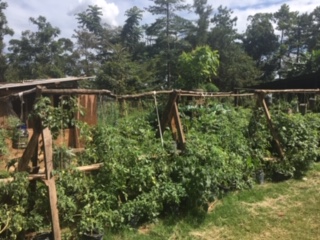

actually had some staff members pick me some fresh kale (what we call collards)
and bananas, which were delicious. I had my first faculty lunch on Friday. The
teachers all eat at the same time and in the staff room, separate from the students
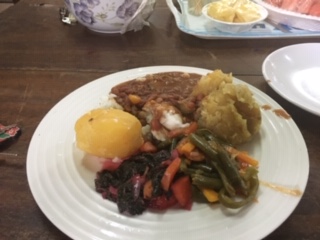
who have their own eating space under a very large shed. Part of what we had for
lunch is apparently a national dish in Uganda, called matooke. If I understood
correctly, it is mashed with flour and steamed in banana leaves. They usually top it
with a ground nut (peanut) paste called binyebwa. Again, if I understood correctly,
the nuts are either roasted or raw peanuts, pounded into a type of meal (like we do
for corn meal) and mixed with something to make it a paste or sauce. The matooke
is very dry so the binyebwa sauce is a must.  They are quite good together. Also
there was herbed rice, a bean dish, some type of fresh picked greens that were
cooked with red onion, and a mashed corn dish.
I had a very similar meal when I
visited the Ndere Centre (more about that in my next post), but I also had Ugandan
sweet potatoes and yams. Their sweet potatoes are actually white, and the yams
are a speckled purple. The terminology throws me off sometimes. When they first
mentioned sweet potatoes I of course thought of the orange sweet potatoes we have
back home. 


Thursday, October 3, 2019

Kyambogo College School

Uganda is a vibrant, beautiful country full of friendly people. Kampala has majestic
hills, and also city streets, both paved and unpaved. Traffic is insane. Probably
worse for me because they drive on the opposite side of the street. If I die here it
will be by motorcycle. I could never drive here. Everyone I encounter speaks
English. It is required in their schools. But even so I have to concentrate to
understand them because their vocal inflections are very different from ours.
I was told that I needed to slow down when speaking because of my accent.
I thought that was very funny.

Tuesday was my first day seeing the school, but Wednesday was my proper introduction and my first full day. The school has 1,000 students and 78 teachers and sits within the grounds of Kyambogo (pronounced CHAM bogo) University. The students have a total of 21 class offerings and at Senior 1 (S1) and Senior 2 (S2) level are expected to take them all. There are 7 compulsory classes-- English, math, physics, chemistry, biology, history, and geography. At Senior 3 (S3) level they are allowed to drop down to three elective offerings and start to tailor their studies towards their interests. The highest level is S6. S5 and S6 are referred to as “A levels”, or advanced levels,  while the lower levels are referred to as “O levels” or ordinary levels. Classes are 80 minutes long, and the students do not change classes-- the teachers do! All instruction is in English. The school day runs from 8am until 4:30 pm, but students are here by 7am. The students are in uniform, and it is refreshing not to have to see sagging pants on boys or too short shorts on girls. Girls must wear knee length skirts and must have short hair cuts. The exception is the Indian and Middle Eastern female students, who can keep their hair long but must wear it pulled back in a bun or ponytail. There are approximately 60 Indian or Middle Eastern students here and one Korean student.  There is some relaxing of the dress code, however as students are also allowed to wear their “house” tee shirts with their gray bottoms. Sort of like Harry Potter, they are sorted into “houses” or groups when they enroll. The houses are all named after animals native to Uganda. Today I saw zebra, lion, rhino, cheetah tee shirts. 


View from the school grounds


I spent most of the day in Mrs. Patricia’s office, which is where my desk is set up. Mr. Okech, who is the assistant to the head teacher took me on a tour of the school.  The head teacher is Helen Twongyiere, and is what we would call the principal. I also was able to observe instructional styles in two classes, a Senior 1 East African history class led by Mrs. Esther, and a Senior 2 English class, led by Mrs. Josephine.


English Class


                                      Pottery produced by the art classes


Tuesday, October 1, 2019

Karibu (Welcome to) Uganda!

I arrived at Entebbe Airport in Uganda at 11:00 pm Sunday night after 28 hours of total travel. It took an hour to clear passport control and customs, so it was 1am Monday before I arrived at my apartment for the month. Dina Apartments is located in the area called Ntinda on a very busy street. 
 Joan, the apartment manger, and Joshua, the night manager, are both extremely nice and helpful. The apartment is quite nice and so far everything I need is within walking distance. They drive on the left side of the road here so I have to be very careful crossing the street.
View from my living room balcony
I met with several faculty members from Kyambogo College School Monday evening for tea and to
Helen Twongiyere, head teacher
discuss more about the project, the problems that they have had that led up to them requesting assistance, and expectations. Spiced African tea is very tasty by the way.  My first Ugandan meal was a vegetable samosa, and it was very good as well. Today-- Tuesday-- will be my first time going to the school, although I learned a bit about it yesterday. I learned that the school is 65 years old, and has approximately 1,000 students in six grades -- what we would call junior high and high school. They are divided into two levels-- "senior level" being the lower grades, and "A level" being the higher grades. Students take seven compulsory courses, and a LOT of what we would refer to as electives, which they only attend once a week. Their classes are also quite large-- up to 100 students!  I am excited, but still a little apprehensive because I desire to do well and be of service.
View from the back stairs of my apartment

The avocado tree by my bedroom terrace

Saturday, September 28, 2019

The Adventure Begins (again)

As I type this I am sitting in Schipol Airport in Amsterdam enjoying a coffee and a croissant with some apricot jam.  It is 7am and pitch black outside. (The wonders of latitude!) The first leg of my journey started yesterday morning when I left Montgomery to drive to Birmingham and drop my dog off with my daughter before heading to Atlanta. The flight from Atlanta to Amsterdam was 8 1/2 hours long-- enough time for me to doze fitfully and watch two movies. I now have another four hours before my second-- and longest flight at 10 1/2 hours before I arrive in Kampala. Hopefully I will be able to sleep on that flight. I may need to double up on the melatonin. However, Schipol is a "silent" airport and they don't make public announcements of flights.  Makes for a peaceful time as I continue to work on my materials for KCS.

Saturday, September 21, 2019

Uganda forever!

On August 30 I received the incredible news that I had been chosen as a recipient of the Fulbright Distinguished Awards in Short Term Teaching Scholarship. Very soon I will be leaving for five weeks in Uganda. While there I will be working at Kyambogo College School as part of a program to introduce learner assessment techniques.  I am honored, excited, blessed, and overwhelmed all at once. The preparation has been lightning quick and super intense: several doctor's visits, numerous immunizations, registering with the U. S. Embassy in Kampala, applying for a VISA, trying to order currency, filing for official eave from my teaching job, prepping resources to take to Uganda, pulling together assignments for my students to do here while I am away... the list seems endless, but so do the possibilities of growth from this experience.  I have have had opportunities several times in the past to travel abroad and learn while doing so.  I am excited to have this chance to impart to others a some of what I know in hopes that it will help improve a child's life half a world away.

Friday, July 26, 2019

Camp Pine Knot


July 9thWe arrived last night to Camp Pine Knot, the first great camp built on Raquette Lake by William West Durant, son of railroad tycoon Thomas Clark Durant. Originally intended to be Durant’s vacation residence, it was later sold to C. P. Huntington to pay for Durant’s debts and renamed Camp Huntington. The Great Camps were wealthy New York City dwellers way of being close to nature without having to deal with all of the hardships of one who lived in nature. Located on a peninsula in Raquette Lake Camp Pine Knot was to be our home for the week.  My room was in Hemlock Lodge.

Hemlock Lodge

This morning we were privy to a lecture by author and Bowling Green University professor emeritus Dr. Philip Terrie. Dr. Terrie has written several novels on the history and politics of the Adirondack area. Dr. Terrie's lecture touched on the politics associated with the wilderness during the Gilded Age. The afternoon lecture was by author and professor Sheila Myers who has written a historical fiction series on the Durant family. 


We then received a history lesson about the great camps from the camp staff who explained how the camp was built. The camps were designed to look as though they sprang from the forest floor. Color schemes are all reminiscent of those found in nature. Each building served a different function and the various functions of life were even separated into different spaces in the buildings. He relied heavily on he knowledge of the people native to the area when it came to planning and building his camps. Parts of the buildings are built Lincoln log style while the later sections of the building were built using birch trees and covering the outside with whole sheets of birch wood. This was a technique that had been used by the Iroquois in constructing their longhouses.  Construction of the camps was arduous.  Any non local materials had to travel by train then over rocky roads in order to get to the building sites.  Large panes of glass had to be transported by foot because they were too delicate to for the bumpy roads. 

The afternoon was built for fun, including canoeing and taking a ride in a sea plane. We Finished the night at the campfire with a discussion about the novel “A Northern Light”.


Forever Wild

On July 7, I -- along with 35 other educators from across the country-- traveled to Cortland, New York where I had the pleasure of being part of the National Endowment of the Humanities week long "Forever Wild" workshop.  Centered on Raquette Lake in the Adirondack Mountains this workshop explored the variety of issues concerning the wilderness during the Gilded Age.  Political, socio-economic issues, gender biases, land use, and private property ownership rights all came into play during this sometimes contentious era.  We started this experience at SUNY Cortland, the sponsoring organization. On our first day we met SUNY Cortland faculty and our hosts for the week Randi, Kevin and Gonda, who put this amazing experience together for us. AND we attended a reception at the home of SUNY Cortland president,  Dr. Erik Bitterbaum. (We fancy, yo!)

On Monday, the 8th our education began in earnest with lectures by both of our faculty hosts, Dr. Randi Storch and Dr. Kevin Steele We started the day at SUNY Cortland and participated in thematic breakout sessions.  My theme was "ethnic lives". My perspective of the Gilded Age began to shift, as I had previously only thought about it from the viewpoints of urban problems. The issues of the wilderness, and the rural people I had never before considered.  Following our morning lectures and group breakout sessions we split into two groups and visited the historic 1890 House and did a city tour.  As part of our preparation for this workshop we were required to complete several readings, one of which was the novel "A Northern Light" by Jennifer Donnelly. The city tour took us past the old industrial section of town, through the Italian section, and past the former homes of Chester Gillette and Grace Brown, the two people around whom's story the novel was based.

The 1890's house is located on Tompkins Street, which was once the wealthiest section of town.  It was
built by industrialist Chester Wickwire and passed to his second son, Frederic, after Chester's death. The 1890s House now operates as a museum.  The house to the right, now the Cortland Alumni House, was built by Charles Wickwire, Chester's older son. And to the left is the Fitzgerald House.  The daughter of the house, Mabel Fitzgerald, would grow up to marry her childhood friend Charles Wickwire.           


The Fernery                                                                                                           


The Fitzgerald House


Charles Wickwire House