Not all those who wander are lost.

Not all those who wander are lost.

Saturday, July 27, 2024

City at the Crossroads of the World

July 25

After a slightly delayed flight we arrived in Istanbul today where we were picked up and transported to the SarniƧ Hotel. The hotel is located inside an old Ottoman mansion and has the type of ambiance that one might expect from such a setting. It is close to all of the major sites in the Old Town section of Istanbul, which is why I chose it. There are drawbacks to staying in an old historic building: the rooms are small, there are no lifts, and WiFi can sometimes be spotty. Because we arrived late, Charisse and I dropped our luggage at the hotel and headed immediately to our first activity: a mosaic lamp making workshop. We were part of an international group of nine.  Our host, Aleyna, was both knowledgeable and patient.


We left the mosaic lamp workshop with our precious bubble wrapped packages and headed to the world famous spice bazaar. Lovely and colorful, it was exactly what I expected a Turkish market to be. We purchased spices, teas, and souvenirs. 
      

Travel tip: wait until you have cleared baggage claim to look for an atm if you need cash. The fees tend to be lower than those in other parts of the airport. 

Thursday, July 25, 2024

Balloon Safari

High on Charisse’s bucket list was riding in a hot air balloon. So we awakened early this morning to meet our driver from Balloon Safari. We loaded into the van where we met our two traveling companions, a mother- daughter duo from the UK. I’ve ridden in a hot air balloon before but this was a different experience. We loaded into the balloon horizontally with the basket lying on the ground. The Mara is beautiful from the air. We saw an exquisite sunrise and many of the same animals that we had seen on our safari. The surprise of the day: sighting two mating hyenas. After the balloon ride was over, we were treated to a champagne breakfast in the savanna. Grazing wildebeests served as our backdrop for a remarkable morning. 


We met up with Sam and Rony at the entrance to the Masai Mara National Reserve to begin our six hour journey back to Nairobi. We checked back into the Radisson Park Inn, but only for a brief few hours, as we had to catch an overnight flight to Istanbul for part two of our journey. 


Phrase of the day: mungu alinipata- “God has got me” - the phrase we’ve used all during our trip whenever something gets stressful or doesn’t go to plan. 

Wednesday, July 24, 2024

Safari!


 July 22 and 23

Our two day safari adventure started on Sunday, July 22nd. We had two short game drives into the Masai Mara National Reserve, one in the morning and one in the late afternoon. The animals aren’t very active during the midday so we went at times we were likely to see the most animals. And we immediately began spotting zebras and warthogs. As we continued the very bumpy ride our eagle eyed guide and driver were both pointing out various animals and native plant life. Charisse’s highlight of the day was the giraffes. Mine was the elephants.


This wasn’t my first safari, but my 2019 safari in Uganda yielded no big cats and no elephants. Therefore I had a lot of excitement regarding what we would see. We lucked up and saw a female lion with two very playful cubs that we nicknamed Toryian and Navi. I learned the difference between the Thompson’s gazelle and the impala, and we also saw an animal I’d never heard of before, called a topi. We then saw a lone water buffalo. Sam informed us that it was an older male who had been expelled from the herd and would remain alone for the rest of its life. During our late afternoon sojourn we saw an adult male lion lounging by himself. 
                             

Day two of our safari was a long day. We left on our gane drive at 8am and didn’t return to the safari camp until nearly 5pm. We entered a different gate this time- a large structure that was crowded by Masai women selling goods. The theme of the day was wildebeests! As far as the eye could see! Having seen 3 of the Big 5 on day one, we didn’t necessarily expect to see the other two. Leopards are nocturnal, and rhinos are not known to be in the Masai Mara. Surprise! We saw a leopard, hidden under some low hanging bushes. He was near a water source where a lot of wildebeests were. The perfect spot for an ambush.


We drove to the Mara River to see hippos and crocodiles and also saw a lot of dead wildebeest bodies floating by. Apparently when crocodiles attack the wildebeests crossing the river, they just take a bite out of them and leave the carcass. We found a juvenile male lion who was enjoying a fresh wildebeest kill. When he got full (and his tummy was VERY full) the carrion eating birds that had been hanging around swooped in and went to work on the leftovers, removing the meat in strips. There are no elephants in this part of the Mara because they don’t like the wildebeests, who are skittish animals.
                          

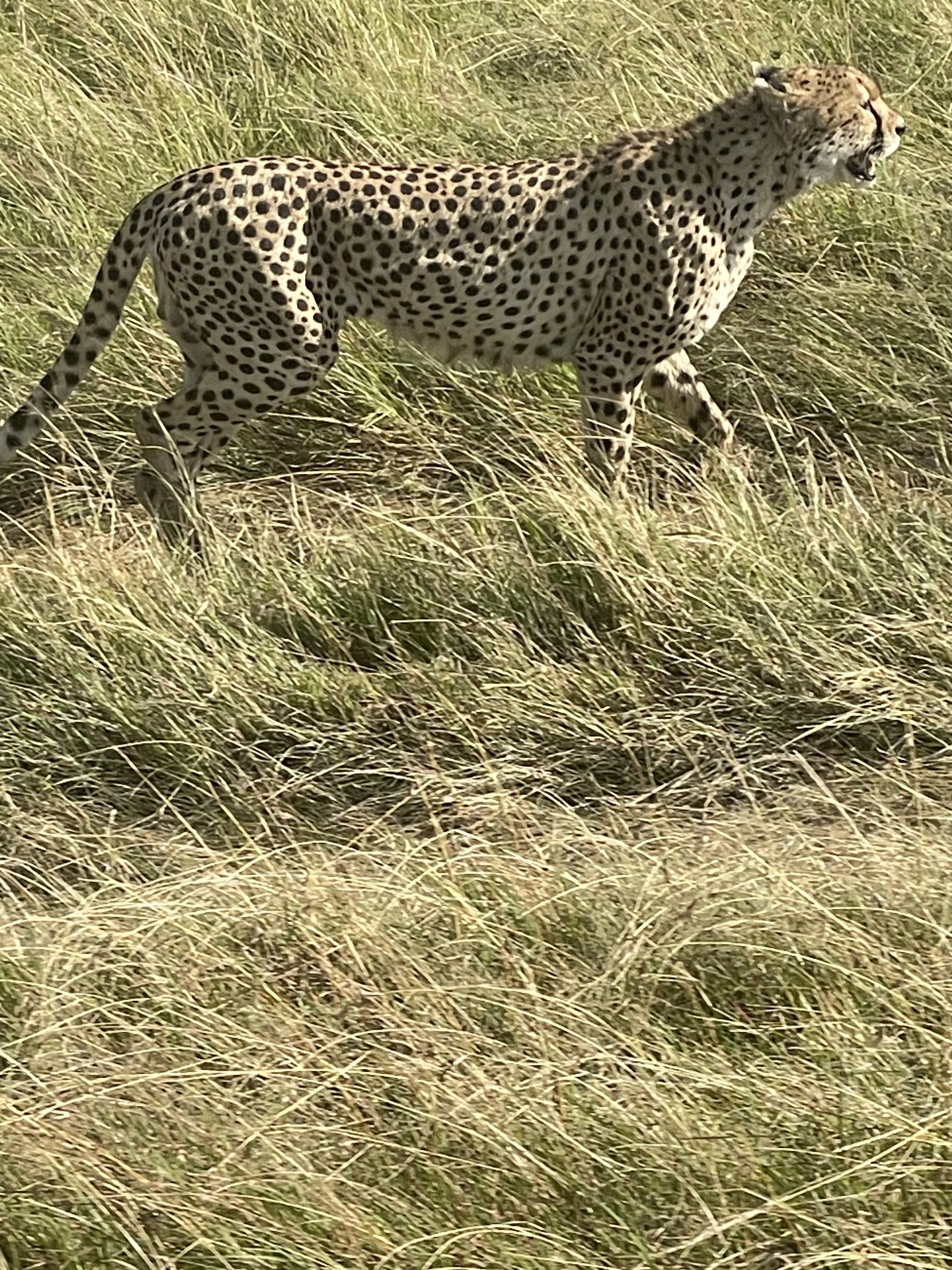
We also happened upon a pair of mating lions and one very large adult male who was clearly in a food coma, as there was a large bloody bone lying next to him. The pair of mating lions caused quite the traffic jam as all the safari driver communicate to each other by radio, so everyone currently in the Mara rushed over to the area. At one point I counted 40 vehicles in that one spot, which created a choke point at the one tiny bridge until one driver got out of this car and started directing traffic. For a while we chased the reports of a cheetah sighting and when we found them, there turned out to be two juveniles who were calling for their mother. Later on that day we spotted a mother cheetah and four cubs who left a small bush to find safety in a larger cluster of bushes. In the middle of the day we enjoyed a packed lunch right there under a tree in  the savanna. 


Word of the day: hapana- “no” - a word I had to use a lot as the women selling wares at the gate were very persistent 

Monday, July 22, 2024

Hakuna Matata

July 21

We loaded into a safari van early this morning with Sam and our driver, Rony, and we headed out on a six hour adventurous drive to our camp in the Masai Mara. 


We made one stop to take pictures at an overlook on the Great Rift Valley, which is a geographical feature that runs from Mozambique to the Red Sea in Israel. 


Everyone shows you their pictures on safari but no one tells you what the drive there is like. The term “road” should be used  VERY loosely. Part of it was nothing but a rocky path. Honestly, the journey was so bumpy that my watch recorded it as exercise. Imagine trying to riding a bronco for three hours. But while driving through the savanna we were treated to many instances of seeing animals in their natural habitats. We saw zebras, warthogs, hyenas, wildebeests, giraffes, Thompson’s gazelles, and antelope. We also saw many farmers and children herding sheep, cows and goats- none of which were in any hurry to get out of the dirt “road” (for lack of a better term).  We arrived at the Royal Zebra River Safari camp and was greeted by Napthali, the manager of the camp. We had an excellent lunch and a brief rest before visiting a Maasai village. 


There we were greeted by a group of Maasai men who performed a welcome dance. As we entered the village the women performed a dance and blessing that ended with a high five. We were lead around the village by “Edward” - not his real name- but a lot of them seem to use English names with the visitors. He told us about the jumping demonstration we witnessed and said the young me do it to attract girlfriends. 


After that we saw a traditional fire making demonstration using sandpaper wood and red cedar. They rub the sticks together in a machete and then use the ember to light a fire in dried elephant dung, which they gather for this explicit purpose. He took us into a hut and explained how women were in control of everything that had to do with the household, including the construction of the huts. The huts are made of cow dung mixed with clay. The roof support is a soft wood and the inner house structure is made of a hard wood. He talked to us about the practice of polygamy among Maasai men before taking us to the Maasai market where we purchased some of their traditional beaded crafts. 


Word of the day: hakuna matata- “no worries”


Sunday, July 21, 2024

Karibu!

July 20

Today was a busy day. We were picked up by Sam of Samton Safaris at 10am and driven to our first stop of the day: the Nairobi National Museum. It is both a history and a natural sciences museum. 


It turns out today was a day for numerous school field trips and there were children EVERYWHERE. We started our tour in the Snake Park, which is located on the museum grounds. Kenya has 140 species of snakes, ten of which are venomous. The black mamba is the fastest and deadliest snake in Africa, but the most dangerous snake is the puff adder because it uses camouflage to hide and often rests near footpaths and walkways. I’m not going to get into the Snake Park too much because it gives me the willies,  but I did learn the difference between a terrapin and a turtle today. Charisse had no such qualms about the snakes and had the opportunity to hold a small python named Raphael at the end of our tour. 


Our tour guide in the museum was a young Masai named Kipain.  He told us quite a bit about the three periods of Kenyan history: pre-colonial, colonial, and post- independence. I learned some very interesting facts during the tour- including that Mt. Kenya is the second highest mountain peak in the world and that the most complete homo erectus skeleton ever found was found here in Kenya at Lake Turkana and is known as Turkana Boy. 


We learned disturbing facts regarding how  the slave trade developed here. In 1498 the Portuguese arrived in Kenya and eventually subjugated the native people, forcing them to work as slaves. Arab slave traders later expelled the earlier Portuguese slavers and traded slaves and ivory to the Middle East. Slaves often worked clove plantations. 


Kipain told us how Masai leaders were tricked into signing over their lands by being told they would be given protection from non friendly tribes. They put their thumbprints on documents, not knowing what they were and then were expelled from their ancestral lands. The Masai used to live in what is now Nairobi. When the company that took their land went bankrupt, white settlers came in and took over the lands. 


The independence movement in Kenya exploded post- World War II. Nationalism and trade union mobilization drove Kenyans to rise up against the colonizers, sometimes with violence. This resistance movement was referred to as the Mau Mau. They used guerrilla warfare against their oppressors. Women acted as spies, using strangler figs to smuggle notes to the resistance. Kenya gained its independence in 1963. 


We also learned some recent history. After the 2007 elections one party did not accept the election results and violence broke out that resulted in 1000 deaths. The seat of impunity was constructed of iron and machetes to commemorate that event. 


In the natural science part of the museum, 

we learned that there are 900 species of butterflies in Kenya and 800 types of bees. The bee exhibit was actually quite interesting. I think Charisse was most intrigued by the bird exhibit, but that was because earlier in the tour we had found out that Masai males between the ages of 13 to 17 go out for 8 days to hunt birds in order to make a feathered headdress called a Motonyi. They are then circumcised and, a few days later, continue their bird hunt. This part of an important rite of passage that marks their transition into manhood. Charisse was traumatized by the fact that even their very colorful national bird is not exempt from this ritual sacrifice. My favorite part of the museum was the Kanga exhibit. Kanga is a beautifully patterned rectangular cloth that usually contains a saying or proverb printed underneath the central figure. 


Our second stop was at Kobe Tough Beads and Leather factory, where Carol, our guide, and a group of workers began our tour with a welcome song. They then showed us the process they use to they create their ceramic beads with clay that comes from Mt. Kenya. The clay is mixed with water and a hardener like silica. It is mixed for two weeks then it sits in the sun for six weeks before it is kneaded, shaped, dipped in paint, decorated, and fired in a kiln to give it its shiny exterior. Kobe Beads was started by a husband and wife team in 2019 to help bring financial independence to women in need. The women who work here are widowed, divorced, or single parents. 


                                                                                                             Next up was the Giraffe Center where we were able to feed giraffes. We were warned not to tease them with the food and also to not get too close because they are know for head butting. We learned that Africa has both Rothschild giraffes and Masai giraffes. 


Finally we went to an African dance performance at Bomas. Boma is the Kenyan word for house. The performance center is shaped like a traditional Kenyan hut. We were treated to spectacular drum, acrobatic, and dance performances that originated in different parts of the country. There were a LOT of school children there. Boisterous and joyful, they would sometimes go bounding down to the floor when the performers encouraged crowd participation. 


Word of the day: Karibu- “welcome”

Today’s lesson: Driving in Nairobi requires a special kind of nerve of which we are not possessed. 


Saturday, July 20, 2024

Sasa from Nairobi


July 19


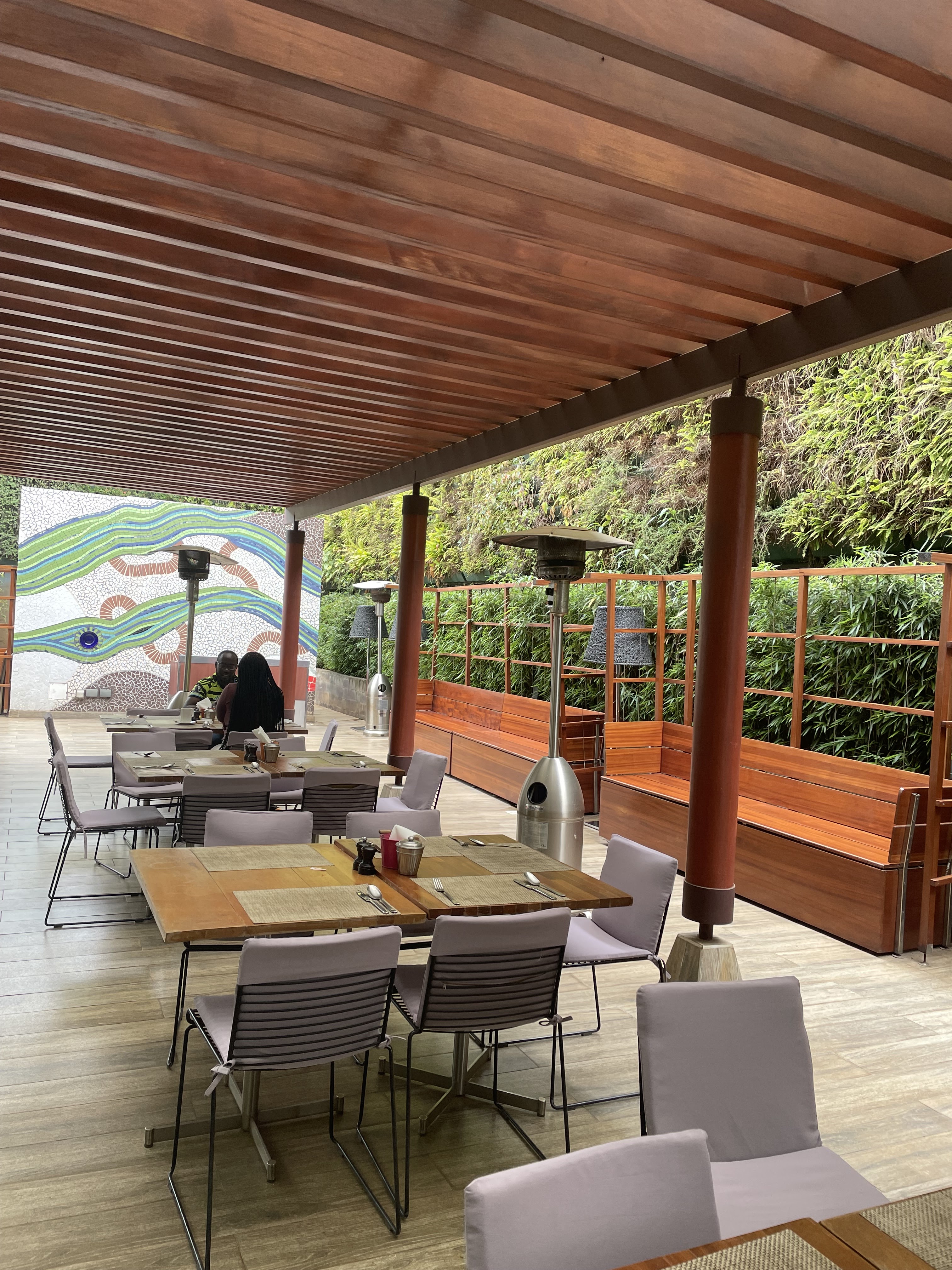
We arrived at Jomo Kenyatta Airport in Nairobi very early this morning. After going through customs, baggage claim, and security we met our driver and got to the Park Inn by Radisson Westlands at about 3:30am. The hotel is very modern and updated, with a very pleasant atmosphere and outdoor terraces.

After 21 hours of traveling we were just glad to finally be able to rest. Charisse and Ross slept in this morning, but I had a mission: I wanted to get my hair done in sister locs. So I had to be up early enough to get breakfast and then meet with our tour guide who took me to Beauty Space Salon. Breakfast consisted of items both familiar and unfamiliar and all of it was very good. I particularly liked the Dahl mahkti, which is a green lentil dish. The mandazi, a sweet bread puff was good but a little dry for my tastes. And the pineapple ginger shot was yummy.

Beauty Space Salon is a very modern hair and nail salon located in a mall in Nairobi. I was not able to get my sister locs because there wasn’t enough time in their schedule today, but I was determined to get my hair done and so the shop owner showed me several different options that could give me the sister loc aesthetic and I settled on artificial locs. The salon is in a mall which was right across the street from another mall.

There I went into Java House coffee shop where I purchased a cappuccino and an orange muffin. By the time I arrived back at the hotel it was time for dinner with Ross and Charisse at the restaurant. Dinner was superb! I ordered grilled halloumi with balsamic vinegar and peppered watermelon as an appetizer, and the Dahl mahkti for my main course. To my delight it was served with chapati, a savory flatbread that I was first introduced to in Uganda. Tomorrow will be our first full day of adventures in Kenya. 
                               
Word of the day: “Sasa”, which is one of the ways they say hello.