Not all those who wander are lost.

Not all those who wander are lost.

Friday, July 26, 2019

Camp Pine Knot


July 9thWe arrived last night to Camp Pine Knot, the first great camp built on Raquette Lake by William West Durant, son of railroad tycoon Thomas Clark Durant. Originally intended to be Durant’s vacation residence, it was later sold to C. P. Huntington to pay for Durant’s debts and renamed Camp Huntington. The Great Camps were wealthy New York City dwellers way of being close to nature without having to deal with all of the hardships of one who lived in nature. Located on a peninsula in Raquette Lake Camp Pine Knot was to be our home for the week.  My room was in Hemlock Lodge.

Hemlock Lodge

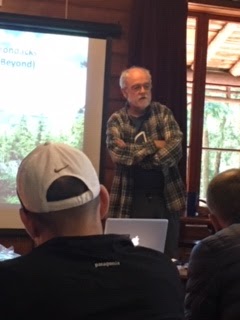
This morning we were privy to a lecture by author and Bowling Green University professor emeritus Dr. Philip Terrie. Dr. Terrie has written several novels on the history and politics of the Adirondack area. Dr. Terrie's lecture touched on the politics associated with the wilderness during the Gilded Age. The afternoon lecture was by author and professor Sheila Myers who has written a historical fiction series on the Durant family. 


We then received a history lesson about the great camps from the camp staff who explained how the camp was built. The camps were designed to look as though they sprang from the forest floor. Color schemes are all reminiscent of those found in nature. Each building served a different function and the various functions of life were even separated into different spaces in the buildings. He relied heavily on he knowledge of the people native to the area when it came to planning and building his camps. Parts of the buildings are built Lincoln log style while the later sections of the building were built using birch trees and covering the outside with whole sheets of birch wood. This was a technique that had been used by the Iroquois in constructing their longhouses.  Construction of the camps was arduous.  Any non local materials had to travel by train then over rocky roads in order to get to the building sites.  Large panes of glass had to be transported by foot because they were too delicate to for the bumpy roads. 

The afternoon was built for fun, including canoeing and taking a ride in a sea plane. We Finished the night at the campfire with a discussion about the novel “A Northern Light”.


Forever Wild

On July 7, I -- along with 35 other educators from across the country-- traveled to Cortland, New York where I had the pleasure of being part of the National Endowment of the Humanities week long "Forever Wild" workshop.  Centered on Raquette Lake in the Adirondack Mountains this workshop explored the variety of issues concerning the wilderness during the Gilded Age.  Political, socio-economic issues, gender biases, land use, and private property ownership rights all came into play during this sometimes contentious era.  We started this experience at SUNY Cortland, the sponsoring organization. On our first day we met SUNY Cortland faculty and our hosts for the week Randi, Kevin and Gonda, who put this amazing experience together for us. AND we attended a reception at the home of SUNY Cortland president,  Dr. Erik Bitterbaum. (We fancy, yo!)

On Monday, the 8th our education began in earnest with lectures by both of our faculty hosts, Dr. Randi Storch and Dr. Kevin Steele We started the day at SUNY Cortland and participated in thematic breakout sessions.  My theme was "ethnic lives". My perspective of the Gilded Age began to shift, as I had previously only thought about it from the viewpoints of urban problems. The issues of the wilderness, and the rural people I had never before considered.  Following our morning lectures and group breakout sessions we split into two groups and visited the historic 1890 House and did a city tour.  As part of our preparation for this workshop we were required to complete several readings, one of which was the novel "A Northern Light" by Jennifer Donnelly. The city tour took us past the old industrial section of town, through the Italian section, and past the former homes of Chester Gillette and Grace Brown, the two people around whom's story the novel was based.

The 1890's house is located on Tompkins Street, which was once the wealthiest section of town.  It was
built by industrialist Chester Wickwire and passed to his second son, Frederic, after Chester's death. The 1890s House now operates as a museum.  The house to the right, now the Cortland Alumni House, was built by Charles Wickwire, Chester's older son. And to the left is the Fitzgerald House.  The daughter of the house, Mabel Fitzgerald, would grow up to marry her childhood friend Charles Wickwire.           


The Fernery                                                                                                           


The Fitzgerald House


Charles Wickwire House


Saturday, June 15, 2019

Sarchí and San José

Our last full day in Costa Rica we headed back to San José, but made a few stops along the way. We passed through a community called Naranjo on our way to Sarchí. Naranjo’s main economic activity is coffee production, and lately they have been competing in coffee competitions. Sarchí is a community of artisans who create authentic Costa Rican crafts, jewelry, and furniture. We stopped and bought souvenirs, had lunch, and went to a presentation on how the traditional Costa Rican ox carts were created. The ox carts were extremely important to the development of the economy in the Central Valley region. Ox cart wheels are made of sixteen wedges angled 22.5 degrees each to achieve the circular wheel. The ox cart machinery is run by a water wheel. And then the designs are free hand painted by the artisans.


We arrived in San José mid afternoon and took a walking tour. I would like to try to explain San José traffic to you but I don’t have words to adequately describe it. And the pedestrian traffic is just as bad as the automotive traffic. We walk at a brisk pace through the crowded, tangled maze that is the city market. Then we stroll for half an hour through the plaza, spending a little time in the Teatró Nacional where I ran into my zumba friend from home Sandra Thompson!


Friday, June 14, 2019

Parque Nacional Manuel Antonio

Friday morning we set out for Parqué Nacional Manuel Antonio. This area is good for spotting Costa Rica’s monkeys. We saw a family of white faced monkeys pretty early in our walk to the beach. White faced monkeys are omnivores and will eat anything they can prey on. The beach is beautiful and the monkeys are plentiful. They will steal any food that you leave unattended which is why the park rangers don’t want food in the beach area. Some unobservant beach goers lost sandwiches and juice boxes while I was watching.


The Alabama Girls!

White faced monkey

Playa Jaco may not be the most kosher town in Costa Rica, but it is definitely a haven for foodies.  I had a wonderful dinner at a restaurant called The Green Room, which was suggested to me by the desk clerk. It had great vegan options.  And I followed that up with Pineapple Basil sorbet at a local gelato place.     


Jungle Fever!

June 13
Today we boarded the bus and headed to the Central Pacific region of Costa Rica. The place we went to, Jacó, is only ten kilometers away from Santa Elena, but because we have to go through and around mountains the trip is actually 40 kilometers and takes two and a half hours.

Our first activity here was a jungle safari boat ride on the Tárcoles River. Five minutes into the tour we saw our first crocodile, nicknamed Osama bin Laden, and his mate, who were stunning themselves on the river bank. According to our riverboat guide the biggest crocodile on this area is 19 feet long and nicknamed Mike Tyson. Gustavo tells us there are about fifty crocodiles per mile in this area. The second croc we saw was nicknamed Fidel Castro. We go practically over the top of this crocodile and drift there for a while. We also see a number of indigenous birds on the tour. One of the birds we see, the bare throated heron, is a predator who feeds on baby crocodiles. All told I saw seven crocodiles, including one as we were coming into the dock that was drifting right in front of us.


After lunch we went to Rainforest Adventures on an aerial tram tour. Our guide, Eric, explains to us that this is a transitional forest. The forest here transitions from dry forest to rain forest. He then led us on a nature hike that included a herpetarium and a butterfly garden. However by this time it was raining so hard that no butterflies were out.


Jacó is a beach town and a large city by Costa Rican standards, with all of the activities, benefits, and problems one would expect from living in a big city. The streets are extremely busy. And some of the activities aren’t exactly legal. The beach itself is nice, with black volcanic sand and stunning sunset views.
The black sand beaches of Jaco. 


Wednesday, June 12, 2019

Monteverde

June 12
Yesterday we drove three and a half hours to the Monteverde region of Costa Rica in the Puenta Arenas province. We stopped half way at a cute little German bakery and purchased some pastries. Later that afternoon most of our tour members went to a local farm and had the experience of milking cows and making sugar cane candy. A few of us— myself included— decided to stay back at our hostel and later go walking to explore the closest town, Santa Elena. This part of the country is known as the cloud forest because of the higher elevation. It is cooler here so air conditioning is not necessary. The vegetation here looks like it belongs in a North American forest rather than in a tropical country.


Wednesday we went to Monteverde Extremo Park for our zip lining canopy tour. I wish I had brought my camera case on the lanyard so I could have video taped this experience. I really need to learn how to work my go pro! It would have taken amazing video. Eight zip lines of varying lengths up to 300 ft high. Zip lining was exhilarating — the stairs required to reach the zip lines were exhausting! And the harness can get uncomfortable after a while.

Afterwards we went hiking in the Santa Elena cloud forest, and later we planted trees at the Don Juan coffee plantation. We planted a total of seven avocado, damas, and balsa trees. Giving back to his beautiful country by helping with its reforestation. We finished off the evening with a Latin Dance class-- my favorite part of the night! 


Dance class with Isabelli!

#thisismonteverde


Tuesday, June 11, 2019

June 10

We started the morning with a chocolate plantation tour. Our guide, Keilor was a bit too talkative for some of the girls. Mostly because he wasn’t talking about chocolate for the first twenty minutes and some of them were getting bored. We did learn that the Cacao plant can produce 200 fruits per year. It takes six months to grow from a flower to a ripened fruit.


Cacao pods are really thick and have to be broken open to get to the white pulpy covered seeds inside. We all got a chance to suck on some cacao seeds. The pulp is really sweet with a texture somewhat like thick yogurt. Sugar, heat, time, and bacteria are needed for the fermentation process for the seeds. This process is sped along by the presence of fruit flies, who’s feet contain the necessary bacteria for fermentation. Then the seeds spend 15 days in the drying box before the beans are roasted. The beans then have to be ground together with cane sugar in order to become chocolate. Everyone got a chance to help grind the cacao beans before tasting. This is raw, unprocessed chocolate before it is pressed together and milk is added to make the milk chocolate that is so common here.


After the chocolate tour we drove back to Arenal Lake— this time for kayaking. This activity was enjoyed by everyone! After kayaking to a small island in the middle of the lake, we went swimming -- and playing in volcanic mud-- for about thirty minutes before we had to kayak back to continue our day.


In the afternoon we visited a local elementary school. The school has grades K-6. The school is very small— 275 students but only nine classrooms. The students come in shifts. There is a morning group from 7-12 and an afternoon group from 12:30-5. The children were extremely welcoming and eager to interact. We spent time in their classroom then played soccer with them for PE! Our team lost 2-1 but everyone had fun.


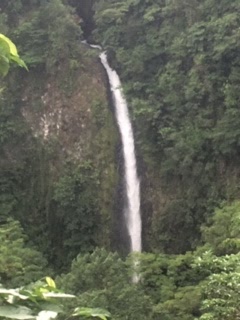
Our next adventure was at La Fortuna Catarata (waterfall). We had a blast until a typical Costa Rican rainy season thunderstorm cut our excursion short. The storm did not stop us from going to the hot springs at the Baldi hotel, however. The springs are heated by the Arenal volcano. They were relaxing and fun, and one spring featured a cave that is a natural sauna.