Not all those who wander are lost.

Not all those who wander are lost.

Wednesday, November 23, 2022

Abu Simbel and Felucca Cruise


4:45am arrives very early on Tuesday. Particularly when you only returned to the hotel 7 hours prior. We pick up breakfast bags from the Tolip Hotel where we stayed last night (I highly recommend this hotel if you are coming to Aswan) and loaded the bus for the three hour drive through the desert to Abu Simbel.
  Abu Simbel is 200 km from Aswan. Once out of the city we drive for miles on end without seeing a single vehicle. I wouldn’t want to have an automotive break down out here. From time to time there are signs of humanity. They are building a new highway through this desert so we pass road crews as well. When we do come to villages and towns, there are checkpoints that we have to pass through. 


The large temple of Ramses II


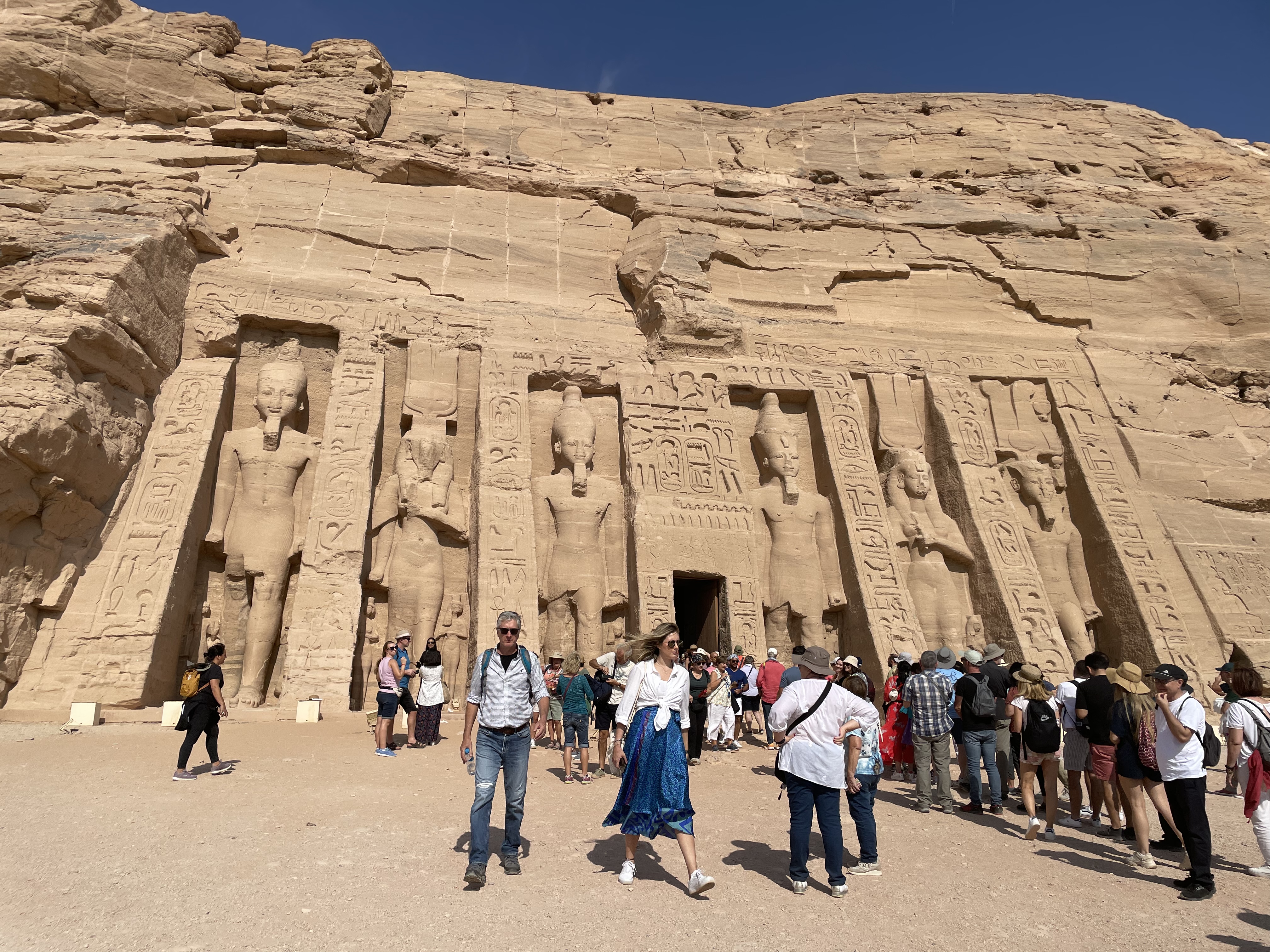
Abu Simbel has two temples carved out of the facade of the mountain. The large temple is for King Ramses II and the small temple is for his chief wife Queen Nefertari. Lake Nasser, where the temples sit, is the largest man made lake in the world. The lake was created to preserve the monuments of the Nubian desert. UNESCO created an international mission to rescue the monuments of the Nubian desert, as they were constantly being damaged by the Nile floods. The temples of Abu Simbel were moved from their original location which is within eyesight of their current location. The mountain and monuments were covered in a thick layer of sand to preserve them while they were cut in layers to prepare for the move. They built a concrete dune to build to hold the monuments in their new location. The monuments, colonnade halls, and chambers were then all reconstructed in the concrete dune.  It took 4 years to move them. The four figures in front of the temple are representations of Ramses II as a god, and the gods Amun Ra, Re-Horakhte, and Ptah. 


The colonnade hall of the large temple 


The ceiling in the colonnade hall of the large temple 

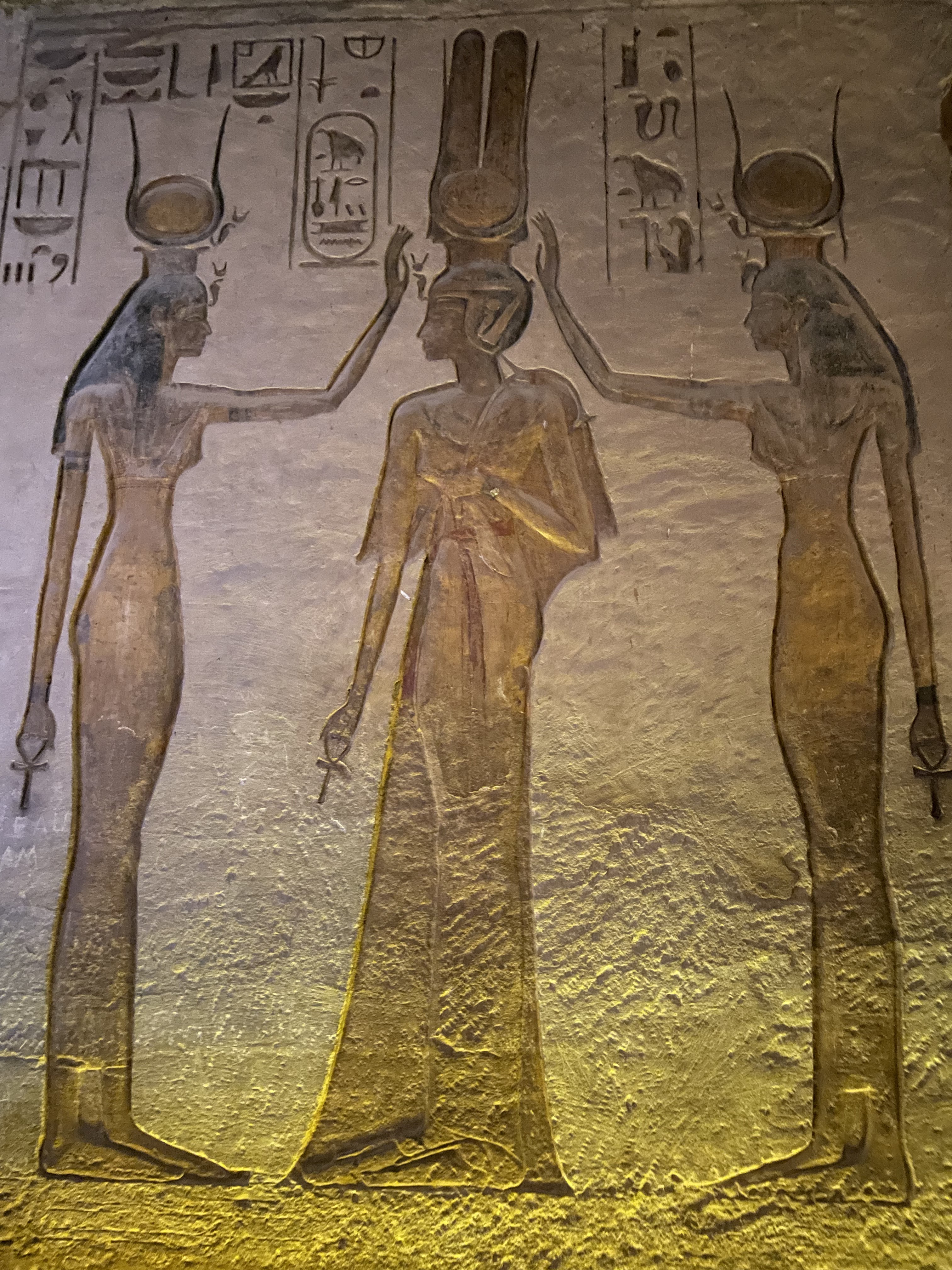
Nefertari’s figure is as large as the gods that are depicted by her in front of her temple. This is unusual for the wife of a king. Queens who ruled would have statues as large as the gods because they were representatives of gods, but the wives of pharaohs were considered merely human and typically not awarded such stature. 

The small temple of Nefertari


Ten of us in the group have opted to do two days aboard a traditional sailing vessel called a felucca. The floor of the vessel is covered from end to end and side to side in a huge, thick pad on which we will sit, sleep, and eat, and is lined with pillows and thick woven blankets. It is very peaceful as we set sail down the Nile in a zigzag pattern headed for Luxor. We only sail during the day so we dock at nightfall and have a communal meal and a lot of conversation before we turn in for the night. A word of warning: Nile mosquitos are vicious! Wear long sleeves and long pants and bring the insect repellent. 


I awoke early our first morning and snapped a photo of everyone else still tucked in for the night. 


My felucca companions! 

We had docked for the night next to our accompanying motorboat, and two other feluccas with their motorboats. I awoke this morning before anyone else, and after going to the toilet on our motorboat, I decided to go for a brief stroll on the shore. Eventually I wandered to the top of a nearby steppe before it occurred to me that I was too unfamiliar with Egyptian wildlife to go wandering, so I turned and came back to the felucca. Once everyone was awake we had breakfast and went to the top level of the felucca to do some yoga in the morning sun. We started on our full day’s peaceful journey zigzagging up the Nile at about 10, passing by green pastures with farmers bringing their cows and donkeys down to the river for water. We also see various other riverboats, modern sailboats, and traditional feluccas along the way. Trains rumble by on the rail line that sits not 50 yards away from the river bank. The topography of the land changes from green fields dotted with trees, to desert cliffs, to lush palm vegetation crowding close to beaches. At about 1:30 we stop at one of those beaches for lunch and take time to wade in the Nile, interacting with some local children who were selling wares down by the shore. After a couple of hours we resume our leisurely journey. We docked again for the night at 5pm, this time with a host of riverboats, feluccas, and escorts to keep us company. After dinner on top of the felucca we had a bonfire on the beach, then turned in for the night. Tomorrow morning we will rejoin the rest of our group and travel to Luxor. 

Dipping my feet in the waters of the Nile River

Tuesday, November 22, 2022

Aswan

We arrived in Aswan this morning (Monday) having traveled overnight by train from Cairo. The sleeper car experience was not what I expected from watching Harry Potter movies. (LOL) It was definitely bumpy and I got very little- if any- sleep. 


My roommate, Bailey, in our sleeper car 

Lights out! 

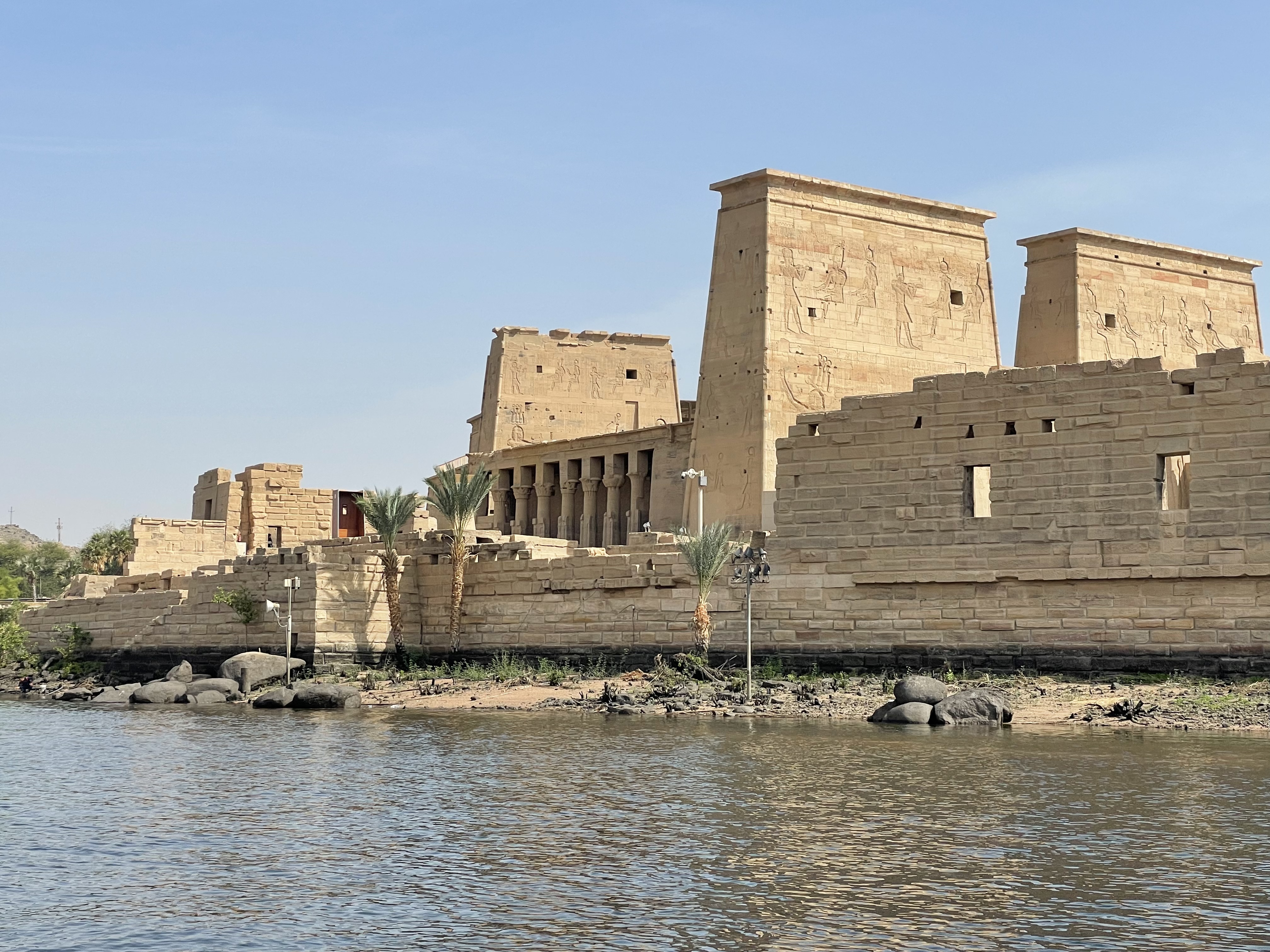
Immediately upon disembarking we headed for the Philae Temple located on the island of Anjelika in the Nile River. A bus took us to the pier and we took a ferry to the island. Adham tells us how the temple is named for the original island where it stood. It was relocated decades ago. In its original location the temple was flooded every time the Nile River flooded. Then the waters would subside, leaving the temple nearly completely covered in slit from the River bottom. There is a black silt line that shows exactly how high the waters used to rise. 


The courtyard 

The entrance to the temple 

View of the temple from the water 

The temple is dedicated to the goddess Isis and celebrates the trinity, Isis; her husband, the falcon god, Osiris; and her son, Horus. The temple was actually constructed during the Greco- Roman era as part of an agreement between Alexander the Great and the Egyptian priests of the south. When Alexander conquered Egypt he moved the capital from the south to the north, and this lost control of the south. He then marched south with his troops and struck an agreement with the priests for the construction of numerous temples where they would be free to practice their religious beliefs. The temples constructed during this era have a mix of Egyptian and Greco- Roman architectural features, as evidenced by the Corinthian style columns on this temple. There are several other small structures and monuments on the island. 


I’m standing inside of the temple of Hathor , one of the smaller structures on the island 


The cartouche of King Ptolemy I

Note the Corinthian style detail at the top of the columns 


The temple facade and some of the statues were damaged when the Romans adopted Christianity as their main religion and they attempted to destroy representations of the non- Christian religion of the Egyptians. 


We journeyed back to the port and boarded to bus to go to the Cleopatra Perfume factory. I think that’s what it was called. There we were given a lesson on essential oils of ancient Egypt and we allowed to sample the oils and essences that they make there.  During our short ride through Aswan I can see that it has a lot less litter than in Cairo. Adham tells us that “Aswan” means “marketplace” reflecting the main economic activities here from long ago. Because the soil here is pink granite, there is very little cultivation of crops. 


At night we went to dinner at the house of a family on one of the many Nubian villages located along the Nile. It took a 40 minute ferry ride to get to the village. The village had a stunningly vibrant market place. The original location of Nubia is approximately 60 kilometers to the south but the people were relocated along the Nile, when the government built dams and created lakes to control the flooding of the river.  The house itself features bright walls and wide open spaces for communal meals. The family was very gracious and kind. The meal was excellent. My favorite dish was the soup that featured orzo pasta. After dinner several of the women in my group got professional henna tattoos by one of the women of the house. 

At the Nubian house- relaxing before dinner 

Bailey holding one of the family’s pet crocodiles. 

Inside the Nubian house

Nubian feast for dinner! 

My henna tattoo. She asked if I wanted a Nubian design. I said “yes”. 

Monday, November 21, 2022

Saqqara and Giza, pt. 2

Giza


The pyramids of Giza have reached the full pyramidal shape. The three pyramids are named Cheops, Khafre and Menkaure, and are known as “father, son, and grandson”. No one knows for certain how the Great Pyramid (Cheops) was built. The Great Pyramid is 149.9 meters high. Apparently if you multiply that distance by 10,000 you get the distance from the earth to the sun. 

Cheops


The second pyramid, Khafre, is 136 meters in height. The bedrock for the pyramid  is limestone bedrock , and the burial chamber is cut into the bedrock to be able to hold the weight of the pyramid. The third pyramid , Menkaure, is 66 m in height. The pyramids are constructed of stones that weigh more than two tons each. No one knows where the limestone originated from. The pyramids used to be covered in soft limestone and had a smooth exterior. You can still see this on the top part of the second pyramid. Muhammad Ali, the ottoman king, removed the soft limestone on the outside of the pyramids to help reconstruct his citadel when it was destroyed. 

One stone is taller than I am. 

The Pyramids of Giza Plateau


There is only one burial chamber inside the second pyramid. The great Pyramid has three burial chambers connected to each other with corridors, and two ventilation shafts.  The construction of the pyramid features air tight construction without the use of cement of any type. And no one knows exactly how the ancient Egyptians did it. That knowledge was all lost with the destruction of the library of Alexandria. There are no hieroglyphics inside the Great Pyramid because they were constructed before the invention of the pyramid text.  We took at short drive so we could get a panoramic view of the plateau, then some of use opted to do the camel ride from there down to the base of the second pyramid. 


We went next into the valley to see the Sphinx. I was so struck by the majesty of the statue that I forgot to take notes here. But I remember Adham told us that the Sphinx is cut from one singular piece of bedrock. The Nile River used to flow directly in front of the Sphinx, which would be covered every time the river flooded. This is one of the reasons the government dammed the river decades ago. The entryway, where the king and his family would enter into the valley, is still intact. The nose of the Sphinx was NOT cut off by napoleon, as we have been told before, but was apparently damaged by a Muslim man who lived close by and was disturbed by the worship of the Egyptian gods. He was discovered damaging the statue and was run off from the area.  


We had lunch at Sphinx Sun 2 restaurant, where the walls were covered in photographs that showed the Sphinx when the Nile River ran through the area. Then we finished up the day at the 3 Pyramids Papyrus Institute where we received a papyrus making demonstration. 

Saqqara and Giza, pt. 1

Saqqara

We had another early start today, leaving at 7:30am for a 45 minute drive to Saqqara to see the pyramids there. Lots of things of note along the way. The most interesting of which was people riding camels on city streets. But there are also mules and horses pulling carts full of fruits and vegetables. The traffic still astounds me. I think we are on a three lane highway but I legitimately cannot tell, as the lane markings seem to be merely a suggestion. And I am again disturbed by the amount of trash piled up by the side of the streets. 


On the way to Saqqara, our tour guide, Adham, gives us the history of how Egypt came to be a unified country, formed from various tribes of nomadic Bedouins who eventually settled along the banks of the Nile.  He talks about the timeline for the three kingdoms of ancient Egypt, the Old Kingdom, the Middle Kingdom, and the New Kingdom, and the ancient Old Kingdom capital of Memphis. During the New Kingdom the capital was Luxor. The Greco- Roman era began around 232 B. C. and lasted until about  AD 280. 


These pyramids were the necropolis for the ancient Egyptian capital of Memphis.  These are step pyramids, and are built this way to take full advantage of the sun. Initially Egyptians dug underground chambers called the mastafa out of the limestone bedrock for burying their dead. The pyramids were later devised as a tomb over the mastafa. The design of the step pyramid happened during the reign of King Djoser. This is an entire funeral complex with an intact entryway and courtyard. 

The entrance into the Saqqara funeral complex 

The mythology of ancient Egypt is based on sun worship. The main god was Amun Ra. They believed strongly in the afterlife. The sun rises in the east and sets in the west, therefore the people lived in the east bank of the Nile and when they died they crossed to the west. Saqqara is on the west, therefore it was significant to death and the afterlife. It contains 40 square kilometers of funeral temples, pyramids and tombs. There are 4 kilometers of tunnels underneath. 


Initially Egyptians did not mummify dead bodies, but once they realized that as the body decomposed, the fingernails and hair would remain they started searching for ways to preserve their dead. They would cut into the body then use a saw to open and spread the chest. The kings, kidneys, intestines,  and stomach were put in canopic jars. The heart was left inside because they would need it to determine where they would spend the afterlife. They then salted the corpse for preservation. They would fill the body with sand so it could keep its shape then sew it back closed. They would then extract the brain by injecting alcohol into the nostrils so that the brain would melt out through the nose. 


Because these tombs are Old Kingdom, they contain no pyramid text. The non- royal tombs are decorated with scenes of daily life. It was a slippery and treacherous journey to get down into the tombs, there are no steps, only a ramp, and you are bent over the entire way down until at last you emerge into one of the chambers. 


Saturday, November 19, 2022

Alexandria

This morning I posted a meme to my Facebook story that said “I want to breathe the air of new places”. Instead I breathed the air of some very old places on my first day in Egypt. Those of us who arrived a day early had the opportunity for an all day add-on excursion to Alexandria. Founded by Alexander the Great and dating back to 332 B. C., it is now the second largest city in Egypt with over 5 million people. It is located on the Mediterranean Sea and is the main sea port for Egypt. It’s approximately a two and a half hour drive from Cairo, so our day started at about 7:30. 


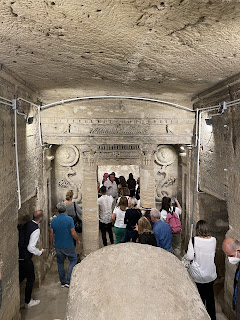
Our first stop in Alexandria was the Tomb of Kom El-Shouqafa. Our tour guide was a charming young lady named Aroba. She tells us that catacombs date back to the 2nd century AD and that they were uncovered by accident  in the early 1900s when a local was walking his donkey and the donkey’s leg fell through the ground. Inside, a winding spiral staircase leads you into the underground chambers. There is familiar iconography everywhere down here. The wings above the door leading to the main burial chamber represent Amun Ra, the Egyptian sun god. The medallions on either side are representations of Medusa and underneath each medallion is a cobra. This mix of cultural representation shows the Greco- Roman influence in Egypt. Inside are reliefs on all the walls with various scenes depicting Anubis, Thoth, Horus, Isis and the Apis Bull. 

The medallion represents Medusa


Entrance to the main burial room


Tigran’s tomb is in a separate structure built in the Ptolemaic- style. The inside of the tomb is painted with frescoes featuring scenes depicting the goddesses Nepthys and Isis. It was moved to this location after the ruins of it were discovered by an archaeologist. 


Our next stop was Pompeii’s pillar. Once there was a temple here, but it’s now in ruins. The pillar is 30 meters high. There are several “rooms” on site. The sanctuary is the sanctuary of the god Apis Bull. The statue inside is a copy. No idea what happened to the original. The small library is the library of the temple of cerapus and was used to store the books underground. These sphinxes once stood at the entrance to the temple. They are seen as guardians for the necropolis. 


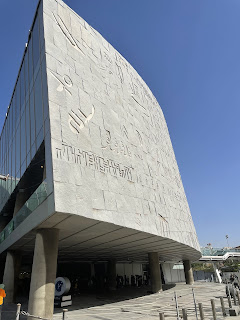
Our final stop was the Biblioteca Alexandrine (the Library of Alexandria). The statue outside the library is made of pink granite and is dedicated to King Ptolemy I. The original library was destroyed over time, beginning with a section that was destroyed during the Alexandrian war. The new design of the library was initiated in 1989 through a competition sponsored by UNESCO. There are three separate structures in the site, including a planetarium. The new library is made of granite blocks from Aswan. The inside of the main reading room is 11 levels and is the largest reading room in the world. It can host 2000 readers at the same time. The architecture has practical purposes but stylistically represents important iconography from ancient Egypt. The walls are made of oxidized bronze and black granite from Zimbabwe. The holes in the wall mimic the slots used for papyrus in ancient times, but their purpose is to muffle sound. The stylized design of the ceiling represents eyes and eyelashes and is designed to protect the eyes of the reader and the integrity of the books.  The library contains 2.5 million books in 80 languages. There is a museum underneath the library, a rare books room and an antiquities museum as well. There is also a children’s museum on the upper floor. If you come here, please know that a separate ticket is required for the antiquities museum part of the library. 

Another of the modern sculptural pieces. It is entitled “A Chess Base” 

This statue titled “A Girl from Nubia” is one of the modern ones in the the museum 

The main reading room at the Library of Alexandria 

Statue in the front dedicated to Ptolemy I

The outside  of the the library 


This piece was created in 1960, and is entitled “Palm Sunday” 

We had lunch at a restaurant called The Fish Market that overlooks the Mediterranean. The vegetarian options were limited but it was decent and the portion sizes were more than adequate. We finished up the day with some shopping at a bazaar near the citadel. 


Tips for traveling in Alexandria:

Public restrooms are not free. They are manned by attendants who must be paid before you can use the facilities. 

 Drivers love their horns and flashers here but not their turn signals. 

Entrance fees to all the sites were really inexpensive 

And the city is unfortunately heartbreakingly dirty and full of litter